

What would we fix if AI didn’t exist?
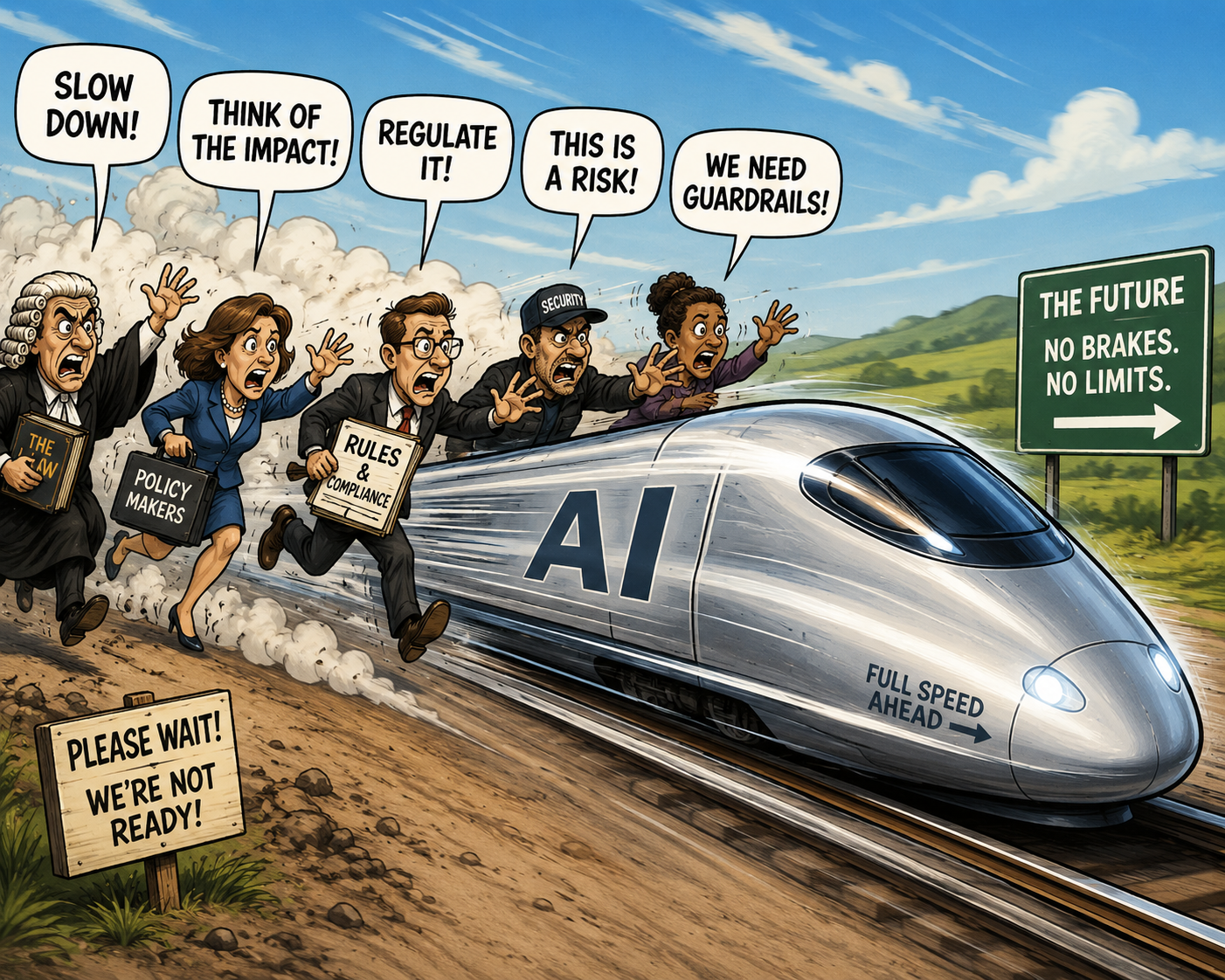
I showed this picture to Laura, my friend and long-suffering reader of this blog.
She looked at it for about three seconds, smiled, and said:
“Yep. That’s exactly how it feels.”
No analysis. No debate. No discussion about large language models, agentic workflows, governance frameworks or digital maturity.
Just immediate recognition.
And honestly, that pretty much sums up how I felt after attending a recent digital transformation conference.
The enthusiasm for AI was everywhere.
The potential is enormous. The use cases are multiplying by the week. Every conversation seems to contain some variation of “AI will transform…” followed by whichever part of society the speaker happens to be interested in.
At the same time, there is an equally loud chorus shouting from the sidelines:
“Slow down!”
“Think about the impact!”
“Regulate it!”
“We need guardrails!”
The image captures that feeling. AI is the high-speed train disappearing into the distance while policy makers, lawyers, regulators, security specialists and risk managers sprint behind it trying desperately to keep up.
But the more I’ve thought about it, the more I’ve realised the image only captures half of the cognitive dissonance.
Because there is another contradiction sitting underneath it.
The first contradiction is speed versus caution.
The second is much stranger.
It’s the growing sense that AI might be a solution looking for a problem.
Now I’m not suggesting AI isn’t useful. I use it every day.
It helps me write. It helps me think. It helps me challenge assumptions. It helps me connect ideas.
I am probably more optimistic about AI than most people I know.
But sitting through conference sessions, I found myself experiencing a peculiar feeling.
Speaker after speaker would explain what AI could do.
And they were right.
Then they’d explain how quickly it was evolving.
And they were right again.
Then they’d explain how organisations needed to start adopting it.
Still right.
And yet somewhere in the back of my mind was a small voice asking:
“Yes, but what problem are we trying to solve?”
That question felt oddly absent.
Not because people were avoiding it.
Because we’re collectively so fascinated by the tool.
For years digital transformation conversations sounded something like this:
“We have a problem. Could technology help?”
Increasingly they sound more like:
“We have a technology. Where can we use it?”
The difference is subtle but important.
It’s the difference between building a bridge because there’s a river in the way and building a bridge because you’ve discovered a really good bridge-building machine.
The conference wasn’t unique in this regard.
You see it everywhere.
We are simultaneously being told that AI will revolutionise productivity, transform public services, redesign work and reshape society.
And all of that may well be true.
Yet many organisations are still wrestling with challenges that are much older and much less glamorous.
Unclear processes.
Fragmented systems.
Poor data quality.
Conflicting ownership.
I was struck by a session discussing shared digital platforms across the Scottish public sector. The presenters made a compelling argument that before we get excited about AI, we need consistent structures, shared data and common foundations.
It wasn’t framed as an anti-AI message.
Quite the opposite.
It was an acknowledgement that intelligence, artificial or otherwise, works best when the underlying information makes sense.
That resonated.
Perhaps the most useful question isn’t:
“How do we use AI?”
Perhaps it’s:
“What would we fix if AI didn’t exist?”
Because if the answer is still worth doing, then you’ve probably found a genuine problem.
If the answer disappears when you remove the AI, then perhaps what you’ve found is a use case rather than a need.
The irony is that AI may ultimately prove most valuable not when it replaces thinking, but when it forces us to think more clearly.
About our processes.
About our data.
About our services.
About what actually creates value.
And perhaps that’s where the real cognitive dissonance lies.
We look at AI and see both the future and a distraction.
Both an extraordinary opportunity and a shiny object.
Both a transformational technology and a very expensive way of avoiding harder organisational problems.
The uncomfortable truth is that all of these things can be true at the same time.
Which brings me back to Laura.
She was right.
That image is exactly how it feels.
Not because AI is running away from us.
But because we’re all standing on the platform trying to work out whether we’re watching the train that will transform everything…
…or whether we’re still trying to decide where we wanted to go in the first place.