

There Is No “They”
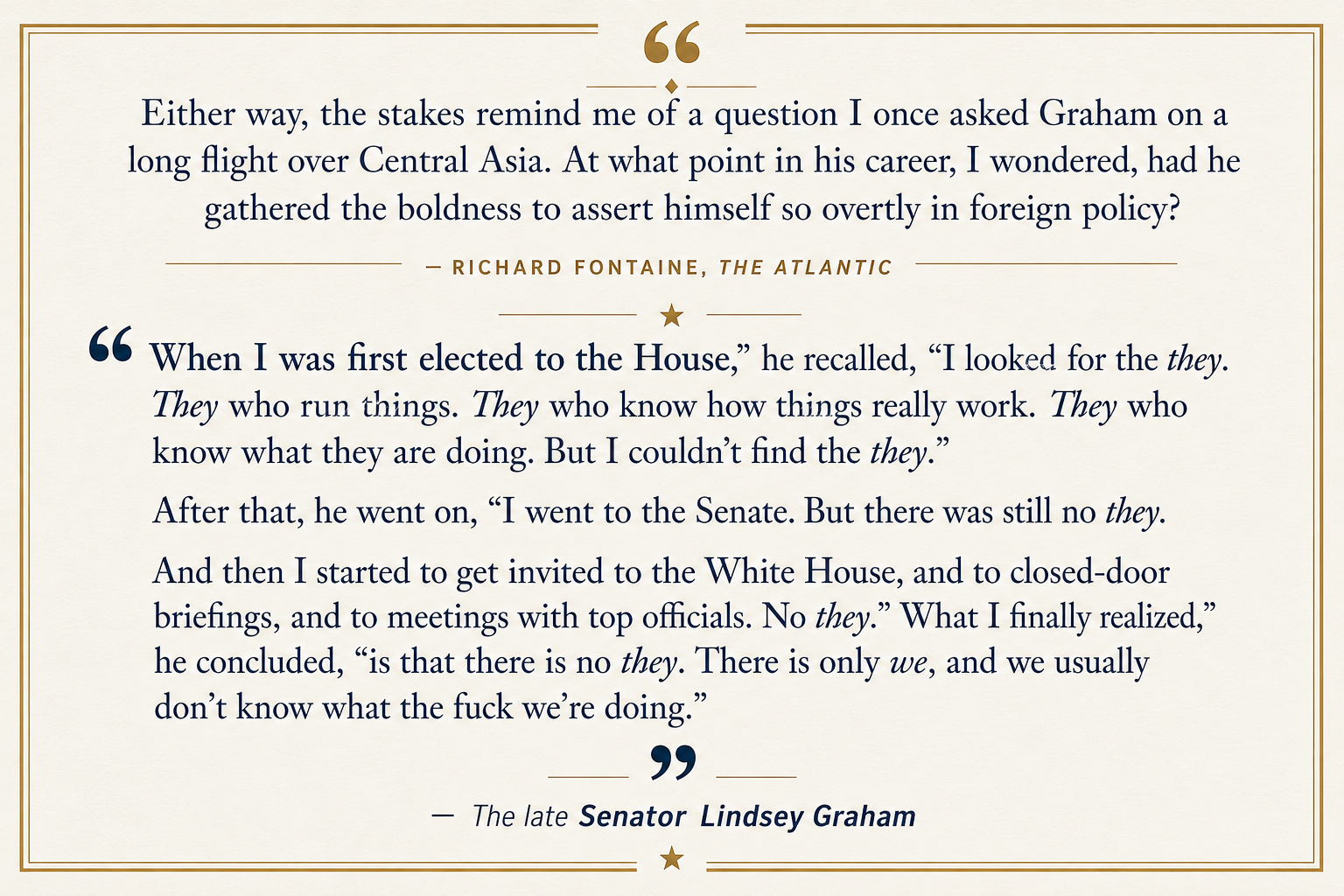
There is a line in the quotation above that has stayed with me, “There is no they. There is only we.”
It describes a realisation that arrives gradually for many of us. Early in our careers, we imagine that somewhere above us, or perhaps just beyond the door of the next meeting room, there is a group of people who fully understand what is happening. They know how the organisation works. They have seen the complete picture. Their decisions are based on information unavailable to the rest of us, and their confidence reflects a depth of understanding we have not yet acquired.
We assume that they know.
This belief can be comforting. It allows us to trust that someone is holding the whole thing together. But it can also diminish us. We stay quiet when something does not make sense because we assume that the flaw must be in our understanding. We hesitate to ask a simple question in case it exposes our inexperience. We defer to confidence, seniority or eloquence, even when the evidence in front of us points in another direction.
I would like to go back and speak to the younger version of myself who entered those rooms believing that everyone else had received a handbook he had somehow missed.
I would tell him that the people around the table are usually working with much the same human equipment as he is, partial information, imperfect memories, competing demands and a limited amount of time. Some will have greater experience. Some will understand parts of the system far better than he does. A few will possess remarkable judgement. But none of them can see everything, and very few feel as certain internally as they appear externally.
The senior person speaking with confidence may be making the best decision they can from an incomplete briefing. The technical expert may understand the mechanism but not the customer’s experience. The person closest to the work may see the problem clearly but not understand how it connects to wider organisational pressures. Everyone holds a piece of the picture. Nobody holds all of it.
That realisation should give us confidence, but it needs to be handled carefully.
The danger is that, once we discover that authority is fallible, we replace excessive deference with excessive certainty. We stop assuming that other people know everything and begin acting as though we do. Confidence hardens into arrogance. We become so pleased to have found our voice that we forget to listen. We correctly recognise that seniority is not proof of wisdom, but then make the equal and opposite mistake of treating our own proximity to a problem as proof that our interpretation must be right.
This is where careful humility matters.
Careful humility is not timidity. It does not mean lowering your eyes, softening every opinion or waiting for someone more important to speak first. It means holding two ideas at the same time, I may have seen something important, and I may still be wrong.
That is a much stronger position than either silence or certainty.
To my younger self, I would say, ask the question. Describe what you can see. Explain why it concerns you. Do not dismiss your own observation simply because someone more senior appears relaxed about it. But do not assume that their disagreement proves they have failed to understand. They may know something you do not. Ask what they are seeing. Test your interpretation against theirs. Remain interested in the possibility that both of you are looking at different parts of the same problem.
I would also tell him that being right is not enough.
Being right is only one part of the story. You can arrive at the correct conclusion for poor reasons. You can identify a real problem without understanding its cause. You can be right about what is happening and still be wrong about what should be done next. Sometimes you can even be right too early, before the evidence is strong enough for others to act with confidence.
There is an important difference between believing that you are right and being able to assure yourself, and others, that your conclusion is sound. Assurance takes time. It requires you to test your reasoning, examine the evidence, look for what might contradict it and understand the consequences of acting on it. It requires patience with questions that may initially feel like resistance. It means being willing to show not only your conclusion, but the path you followed to reach it.
When people ask how you know, they are not necessarily dismissing you. They may be trying to establish whether the conclusion is dependable. They may need to explain it to someone else, commit resources to it or accept the risk that follows from it. The greater the consequence of a decision, the less useful it is simply to insist that you are right.
This can be frustrating, particularly when the answer feels obvious. My younger self sometimes believed that seeing the truth of something should be sufficient. If the logic was clear to him, why could others not simply accept it? With experience, I have come to understand that confidence cannot always be transferred through conviction. Other people need a basis on which to place their trust.
That basis may include data, experience, professional judgement, consultation, testing or simply the passage of enough time for patterns to become visible. It may require the same question to be examined from several angles. It may involve bringing together people who each hold a different part of the picture. None of this makes the original insight less valuable. It makes it more usable.
The most useful confidence in the workplace, then, is not the confidence to declare that you are right. It is the confidence to make your thinking visible.
That means being able to say:
“This is what I think is happening.”
“This is the evidence I am relying on.”
“This is the assumption I may have wrong.”
“This is how I have tested the conclusion.”
“This is what would change my mind.”
Those statements do not weaken an argument. They make it more trustworthy. They allow other people to examine the reasoning rather than merely reacting to the force with which it is expressed. They create a route from personal conviction to collective assurance.
I would also tell my younger self not to confuse fluency with understanding. Some people can speak decisively about almost anything. They produce an answer before others have finished forming the question. Their certainty can fill a room and create the impression that the matter has been settled.
But speed is not always clarity, and confidence is not evidence.
Equally, hesitation is not always weakness. The person who pauses may be considering consequences that the quickest speaker has missed. The colleague who qualifies an answer may have a more mature understanding of uncertainty. Someone who says, “I don’t know,” may be demonstrating more professional confidence than someone who produces an immediate but fragile explanation.
Real confidence is spacious. It leaves room for another person’s knowledge. It can survive a difficult question. It does not need disagreement to be disloyalty or correction to be humiliation. It is capable of changing shape when new information arrives.
Arrogance, by contrast, is often brittle. It needs to win. It treats uncertainty as a threat and questions as challenges to status. It listens mainly for weaknesses to attack. It can look powerful, but it frequently hides insecurity, the fear that being wrong about one thing might undermine everything.
The older I become, the less impressed I am by certainty on its own. I am more interested in how someone reaches a conclusion, how they test it, how they respond when challenged and whether they can distinguish between what they know, what they believe and what they are merely assuming.
That is the standard I would encourage my younger self to apply to others, but also to himself.
Because the discovery that there is no mysterious “they” brings responsibility as well as reassurance. Once we understand that organisations are not controlled by an all knowing intelligence, we can no longer simply wait for someone else to notice what is wrong. The organisation is made and remade through the choices of the people inside it. Its blind spots persist because ordinary people fail to question them. Its better decisions emerge because someone notices, asks, listens, tests and helps others see.
There is only we.
That does not mean every voice carries the same knowledge, authority or accountability. Experience still matters. Expertise matters. Roles matter. But none of those things removes the obligation to think, and none should exempt a person from listening.
So I would tell my younger self to enter the room differently.
Do not enter assuming that everybody else knows more than you.
Do not enter determined to prove that they do not.
Enter curious about what each person can see.
Bring your own observations without apology. Hold your conclusions with enough confidence to explain them and enough humility to examine them. Give yourself the time to move from instinct to understanding, and give others the evidence and reasoning they need to move with you. Listen not merely as a courtesy, but because another person may possess the missing piece that changes the meaning of everything in front of you.
And remember that the goal is not to become one of the mythical people who always knows what to do.
The goal is to help create a workplace in which people can think together honestly, without hiding uncertainty, worshipping hierarchy or mistaking volume for wisdom. A workplace in which being right matters, but being rigorous, open and trustworthy matters just as much.
That may be the most mature form of confidence available to us, not the certainty that we know, but the quiet belief that we have something worth contributing, the patience to assure ourselves that it stands up, and the humility to recognise that everyone else may have something worth contributing too.